
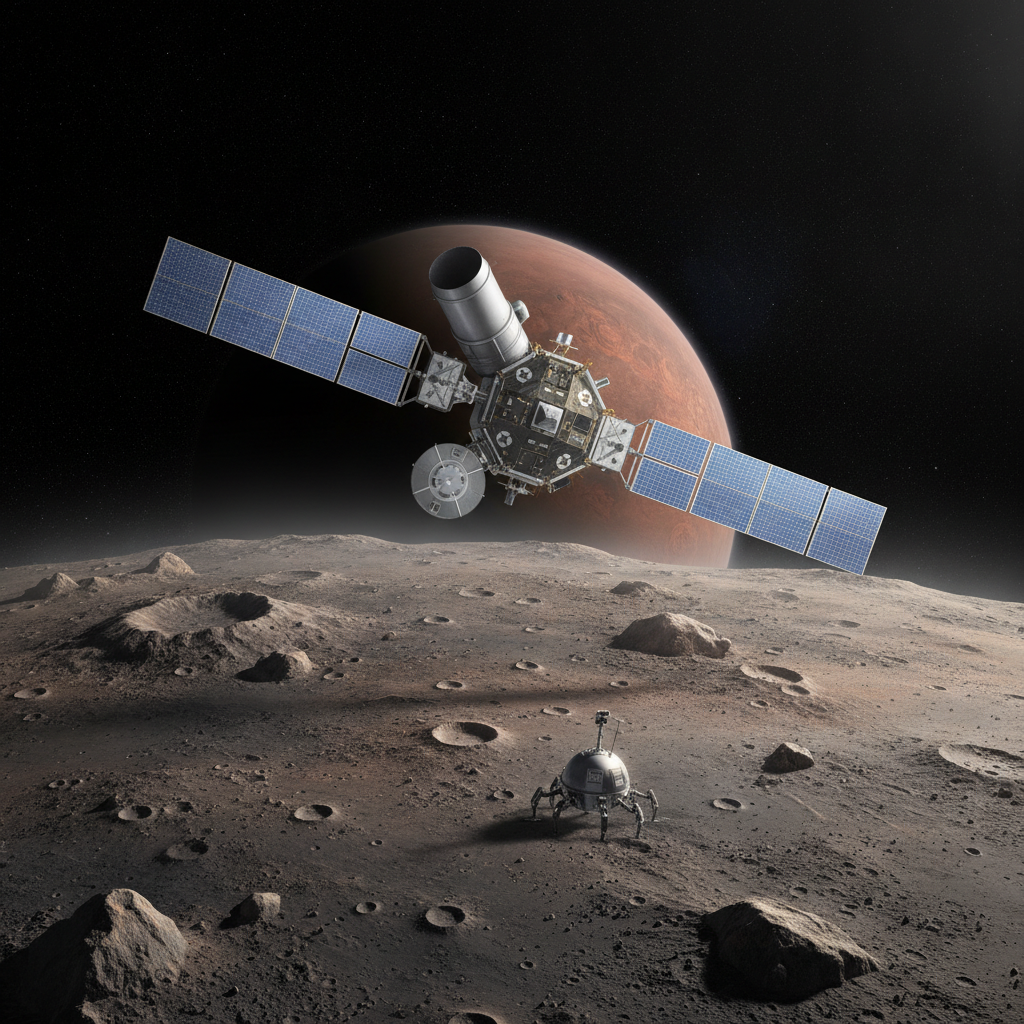
Japan has launched its $578 million Martian Moons eXploration mission, embarking on an ambitious five-year voyage to land on Mars’s largest moon, Phobos, and return pristine surface samples back to Earth.
The robotic MMX probe lifted off from the Tanegashima Space Center aboard a 207-foot H3 rocket, marking the debut of an upgraded configuration featuring four strap-on solid boosters, full-throttle main engines, and an enlarged payload fairing. Flying at speeds exceeding 24,000 mph to break free of Earth’s gravity, the 9,900-pound spacecraft successfully separated roughly 71 minutes into flight and established contact with mission controllers. It is now on a 10-month cruise toward Mars, with arrival scheduled for next August.
Because the weak gravitational pull of Phobos makes a standard orbit impossible alongside the gravitational influence of Mars, MMX will maneuver in a quasi-satellite orbit around the potato-shaped, 14-mile-wide moon. Operations will intensify in late 2028 or early 2029 with the deployment of Idefix, a shoebox-sized rover developed by the French and German space agencies designed to explore the rugged surface for up to 100 days. Later in 2029, the main MMX mothership will attempt up to two surface touchdowns using specialized landing gear engineered to absorb shock and prevent bouncing.
During its brief stays on Phobos, the lander will collect at least 10 grams of regolith using both a robotic coring drill and a NASA-supplied pneumatic system that blasts high-pressure nitrogen gas to gather loose material. The spacecraft will then blast off, jettison its landing stage, and ignite its engines in 2030 to return to Earth. A sample return capsule is slated to touch down in South Australia in 2031, with NASA receiving a 15 percent share of the recovered specimens in exchange for instrument contributions.
Building on the heritage of Japan’s Hayabusa asteroid missions, the project aims to resolve whether Phobos is an ancient captured asteroid or the product of a massive collision with Mars. Because the moon orbits exceptionally close to Mars, researchers also anticipate the collected regolith could contain material blasted off the Martian surface itself, providing direct laboratory access to Martian matter ahead of dedicated surface sample return attempts.
Source: arstechnica.com