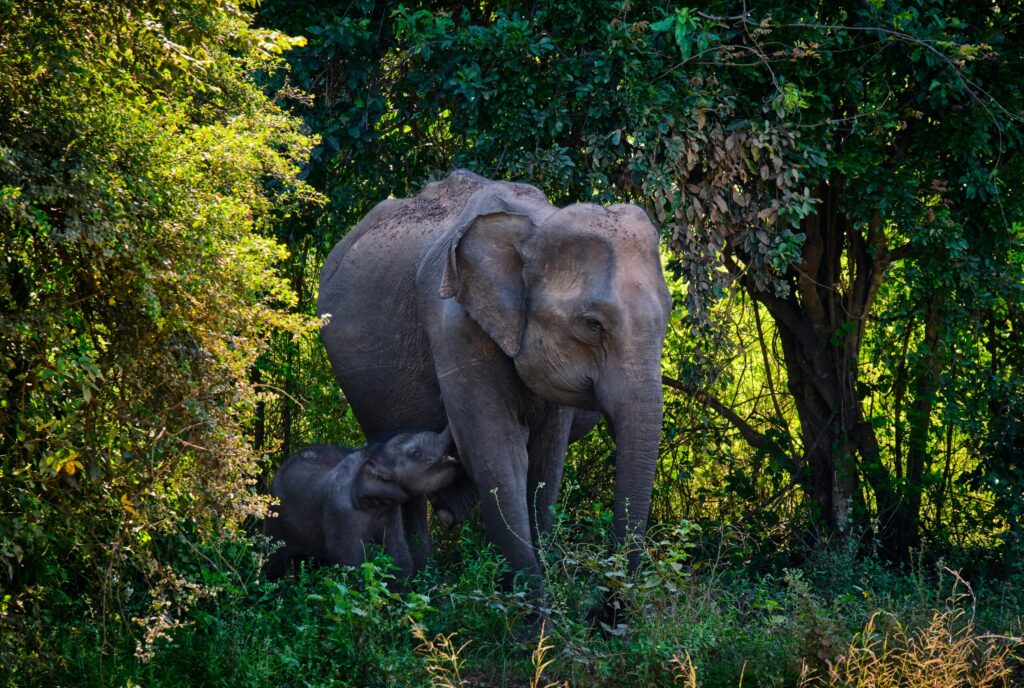
Persistent population loss does not merely shrink wild Asian elephant groups—it causes their complex social networks to fracture into smaller, isolated clusters, according to a 12-year study conducted in Sri Lanka.
The research, published in the journal Science by University of California, San Diego ecologists Anastasia Madsen and Shermin de Silva, monitored 443 adult and subadult female elephants in Udawalawe National Park between 2007 and 2018. While African savanna elephants have demonstrated an ability to rebuild social ties following sudden mortality events such as poaching, the team discovered that gradual, compounding losses eventually overwhelm the resilience of Asian elephant communities.
The decline within the park was driven largely by ecological changes. Grasslands that formed around a 1970s reservoir originally provided abundant grazing, drawing dense herds to the area. Over time, however, aggressive invasive shrubs such as lantana created impenetrable thickets devoid of edible vegetation. With forage dwindling, fewer calves survived to maturity, fewer outside elephants entered the park, and deaths or departures began outstripping newcomers around 2012. By 2018, roughly 69 percent of the females identified at the start of the study had disappeared.
Using algorithms often applied to human networks, the researchers tracked how individual association patterns shifted as numbers dropped. Even among a core group of 59 resident elephants present across every year of the study, social structures deteriorated within one to three years after population losses began outnumbering replacements. The first connections to dissolve were weak ties—casual acquaintances between animals—which scientists suspect help maintain peaceful tolerance across broader communities and allow information to travel between groups.
Before the social networks disintegrated, the researchers noted sharp year-to-year statistical fluctuations termed “flickering,” a phenomenon observed in complex systems nearing a breakdown. Madsen and de Silva noted that tracking these network shifts could offer conservationists an early warning system to intervene before local populations collapse, especially as adult females increasingly succumb to human conflict, vehicle infrastructure, and habitat degradation decades before reaching their natural lifespans.
Source: arstechnica.com