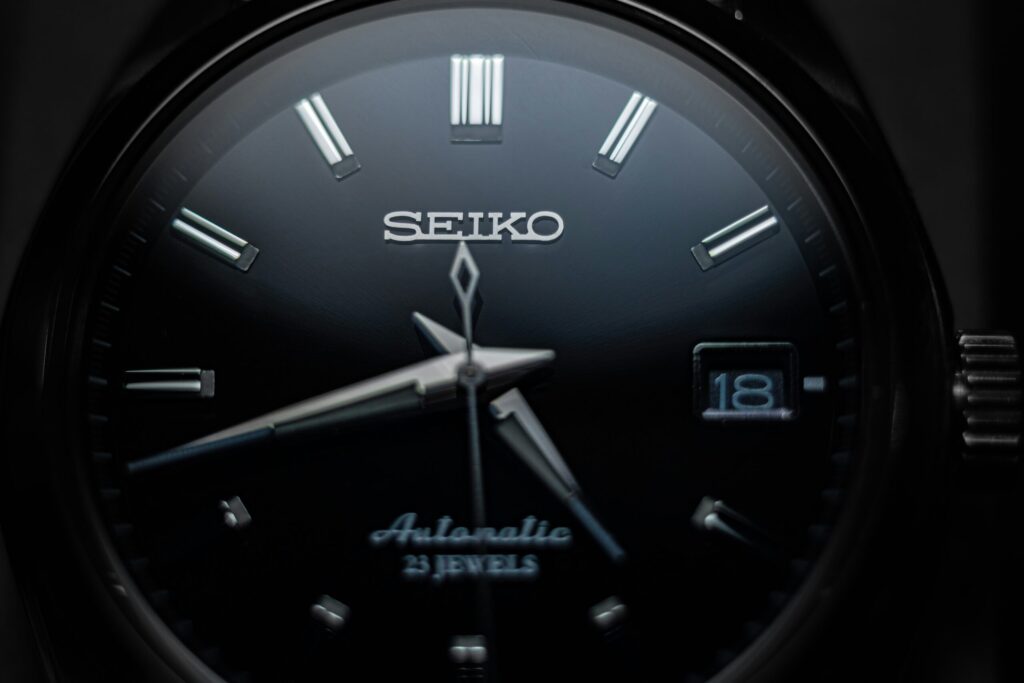
Seiko made horological history in 2012 by introducing the Astron GPS Solar, the world’s first solar-powered wristwatch capable of receiving GPS signals to automatically identify time zones and set local time anywhere on Earth. Among the debut collection was the SAST001, a technologically ambitious limited edition that integrated satellite connectivity into wristwear without requiring battery replacements.
Fitting the necessary satellite communication components required substantial case dimensions, giving the SAST001 a 47mm diameter and a thickness of 16mm. A primary contributor to this volume was an internal 38mm ring antenna engineered to catch satellite signals. Despite its bulky silhouette, the watch maintained an overall weight of 125 grams—approximately half the weight of an equivalent steel model—by utilizing a blackened High-Intensity Titanium case paired with a rounded ceramic bezel and compact lugs.
Seiko produced the black SAST001 as a numbered run of 2,500 pieces within a six-model launch range. The watch featured a layered, three-dimensional dial layout accented in copper tones beneath a flat sapphire crystal treated with Super-Clear Coating. Instead of surfacing the entire face with photovoltaic material, designers placed miniature solar cells around the elevated hour markers, helping preserve visual depth while maintaining continuous light absorption.
Later generations of the Astron GPS Solar refined the platform with smaller cases and more traditional styling, moving away from the gadget-oriented design of the pioneer. Nonetheless, the original 2012 SAST001 established the technical baseline for light-powered, autonomous global timekeeping in modern watchmaking.
Source: fratellowatches.com