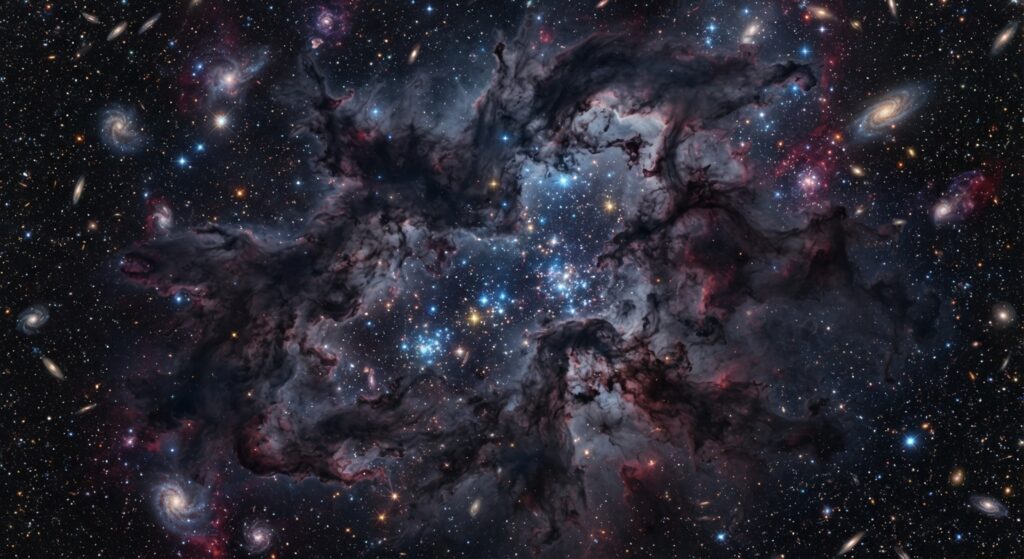
Astronomers have identified an enormous candidate dark galaxy containing roughly two billion solar masses of hydrogen gas that appears to be rotating despite exhibiting no signs of star formation.
The findings, published in the Monthly Notices of the Royal Astronomical Society by researchers at Swinburne University of Technology in Australia, center on an object cataloged as AGC 322753. Scientists cross-referenced observations from Puerto Rico’s Arecibo Observatory and China’s Five-Hundred-Meter Aperture Spherical Radio Telescope, both of which registered a massive concentration of neutral hydrogen. Crucially, the radio emissions produced a distinct two-peaked signal indicating that one side of the cloud is moving toward Earth while the other recedes—a hallmark of an organized, rotating disc.
That rotation directly challenges existing theoretical simulations of galaxy evolution under the standard Lambda-CDM model, which predict that starless dark galaxies should not rotate. Furthermore, deep optical data from the DESI Legacy Imaging Surveys showed no detectable starlight from the object. This led investigators to calculate that AGC 322753 contains at least 40 times more mass in hydrogen than in stars, raising significant questions about why its cold gas failed to collapse and ignite.
Astronomers emphasize that additional radio observations, including work with the Very Large Array in New Mexico, will be required to confirm the structure’s identity. Prior dark galaxy candidates have sometimes been reclassified as tidal gas tails stripped from neighboring systems, though researchers note there is no apparent companion galaxy nearby to account for AGC 322753. Discrepancies in sky positions between the two initial surveys also leave open the possibility that the object is a diffuse gas cloud rather than a cohesive galaxy.
Source: WIRED