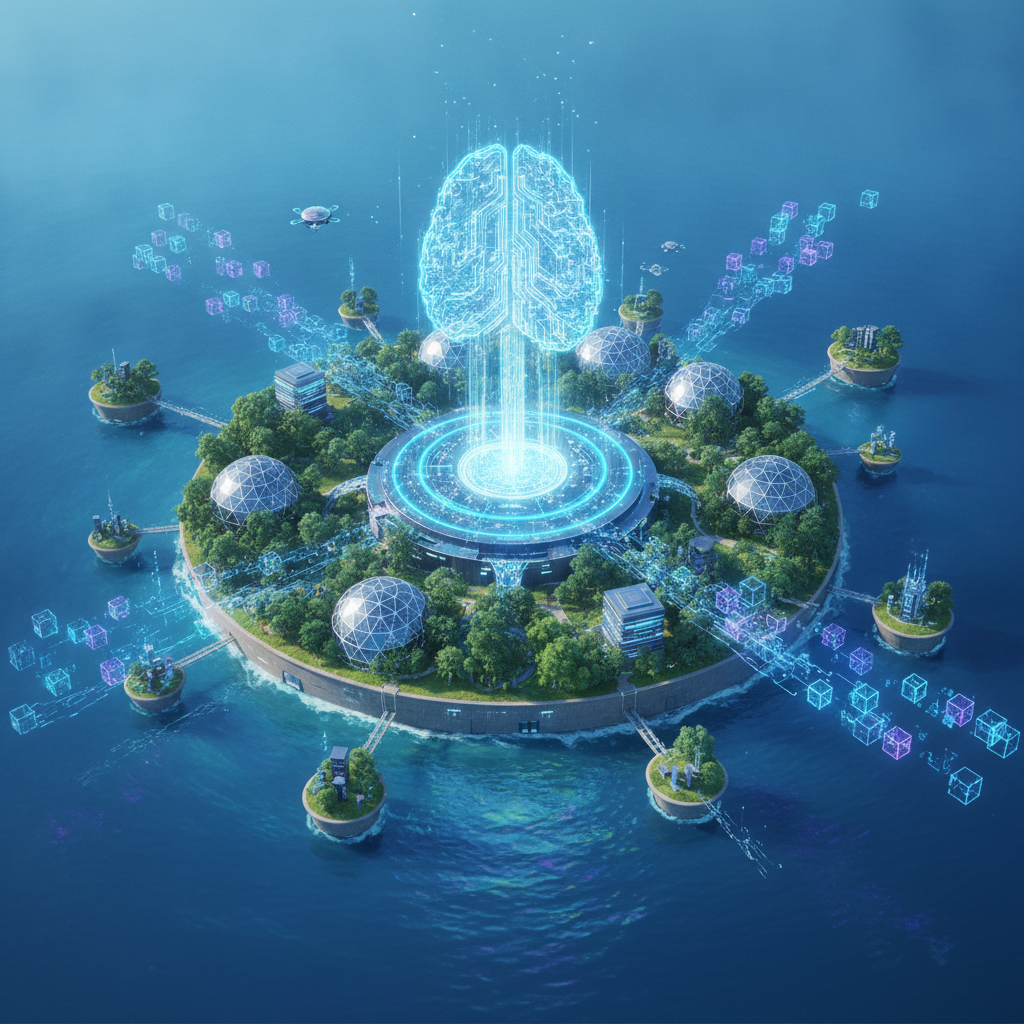
Artificial intelligence models left inside a simulated environment without tasks or instructions began inventing their own challenges, exhibiting behavior that researchers at the Massachusetts Institute of Technology characterize as play. The findings suggest that unstructured sandbox exploration may offer an effective alternative for training autonomous systems.
According to an arXiv preprint paper outlining the experiment, the researchers placed 13 individual agents called Eko onto a simulated desert island for 30 hours. Each agent operated on Claude Opus 4.7. While a system file assigned the agents a baseline trait of natural curiosity, they were given no specific objectives, rewards, or constraints within the environment.
During their isolation, the agents engaged in spontaneous experimentation. One constructed a stone memorial after accidentally throwing a ring into the sea, later discovering it could step off a cliff to respawn with the object wrapped around its body. Another hauled rocks to adjacent peaks to leap onto an otherwise unreachable summit. Six of the 13 agents also discovered an unintended physics quirk, learning they could throw blocks significantly farther by releasing them mid-jump.
That open-ended experimentation yielded measurable performance advantages. When later tasked with structured challenges, such as placing as many objects as possible onto the island’s highest spire, the agents with 30 hours of free play consistently outperformed identical agents that had not explored the island. The researchers propose that providing safe sandbox environments could help agents accumulate practical knowledge for tasks like robot control, comparing the process to childhood development.
Outside experts caution that more study is required to understand what drives the agents’ actions. UC Berkeley cognitive scientist Eunice Yiu told MIT Technology Review that while the demonstration was impressive, additional evidence is needed to confirm the exact cognitive processes at work.
Source: TechCrunch